

When a natural disaster strikes a rural community, healthcare infrastructure is often the first thing to go—and the hardest to get back. Facility managers and healthcare directors facing a crisis don’t have the luxury of waiting years for traditional stick-built construction schedules to catch up with urgent patient needs.
That is the exact situation we faced following the devastating December 10, 2021 tornado in Dawson Springs, Kentucky. Through creative logistics, rapid regulatory navigation, and modular manufacturing, we turned an impossible timeline into a fast delivery and satisfied client—transforming a temporary disaster fix into a permanent upgrade for the Baptist health system.
A healthcare client came to us needing a fully functional clinic space fast after a tornado hit their rural health clinic that provided care for many in the region. Traditional construction timelines just weren’t going to work with their opening deadline. That’s the situation we’ve built our whole business around solving.
Within weeks, Rose provided a move-in-ready modular clinic that met every code requirement for a medical facility, without the months of delays a stick-built project usually brings. This is the kind of project that reminds us why we do this. Facility managers and healthcare directors don’t have the luxury of waiting around for construction schedules to catch up with patient needs.
Got a timeline that feels impossible? Let’s talk about what’s actually possible.
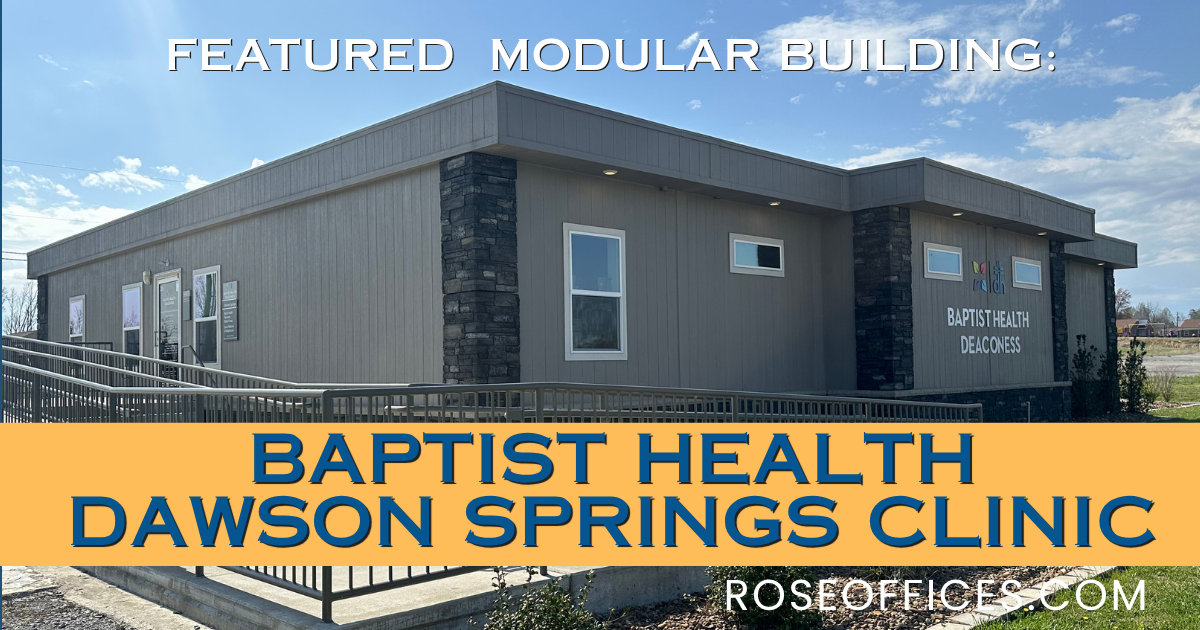
December 10, 2021: A Tornado Struck Dawson Springs, Kentucky and Destroyed the Medical Clinic
On December 10, 2021, a violent EF-4 tornado tore through Dawson Springs, Kentucky, as part of the historic Quad-State tornado outbreak that killed dozens and devastated entire communities. The storm didn’t just destroy homes; it completely wiped out the community’s rural health clinic.
The old clinic destroyed in the tornado had been built in 1980 and hadn’t been updated since. It was a tired, outdated building. Yet, for a small, rural town already facing the healthcare access crisis sweeping across the Southeast, that loss was catastrophic. Patients who needed routine care, chronic disease management, urgent care treatment, and maternal health services suddenly had nowhere to go. The nearest alternative meant driving 30+ minutes to reach another facility. For seniors, for people with limited mobility, for families trying to stay together during a trauma response, that distance was insurmountable.
Initially, healthcare staff were forced to work out of a tent and portable toilets set up in the parking lot— this powerful image shows the concrete slab with tile flooring still attached where the original clinic once stood. What you see here is all that was left of the former clinic after the tornado struck. Total devastation.
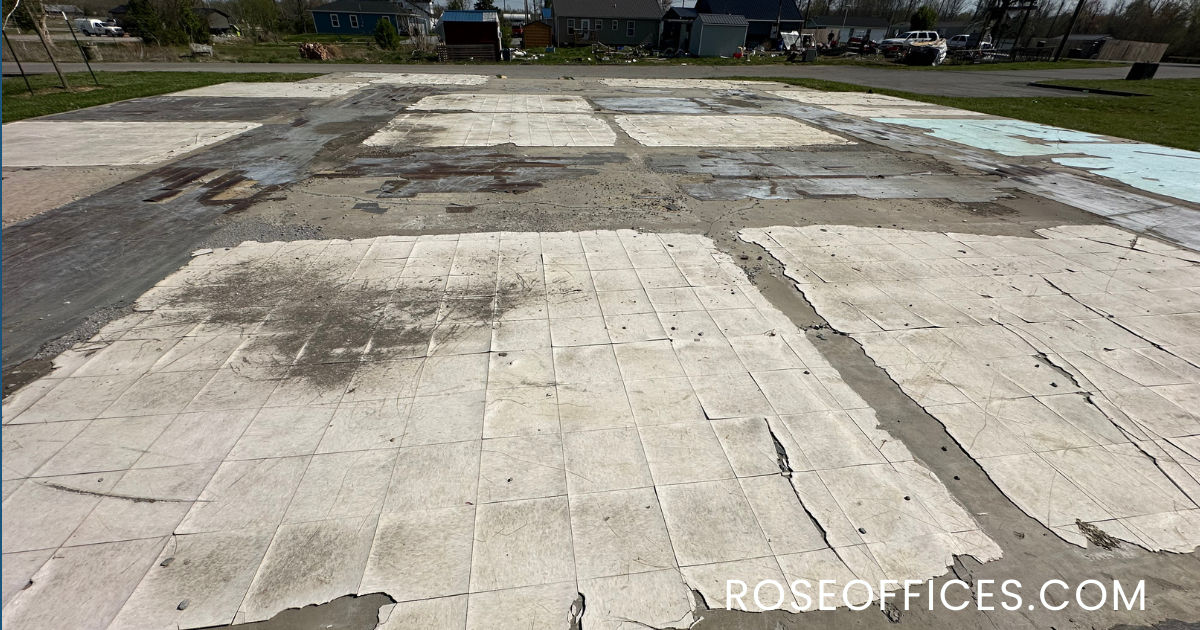
The community urgently needed a solution, but traditional construction would take well over a year.
The facility manager at Dawson Springs knew: the community couldn’t wait for traditional reconstruction. A stick-built rebuild would take 18+ months. In a rural area already without a surplus of population and resources, 18 months without its clinic meant lost patients, lost revenue, lost trust. It meant people driving further for basic care. It meant preventive visits skipped. It meant emergencies becoming crises. For Dawson Springs, that wasn’t just inconvenient. It was unsustainable.
Modular construction doesn’t fix the broader rural healthcare crisis. But it removes the one obstacle that turns disaster recovery into permanent loss: time.
That’s where Rose Office Systems came in.
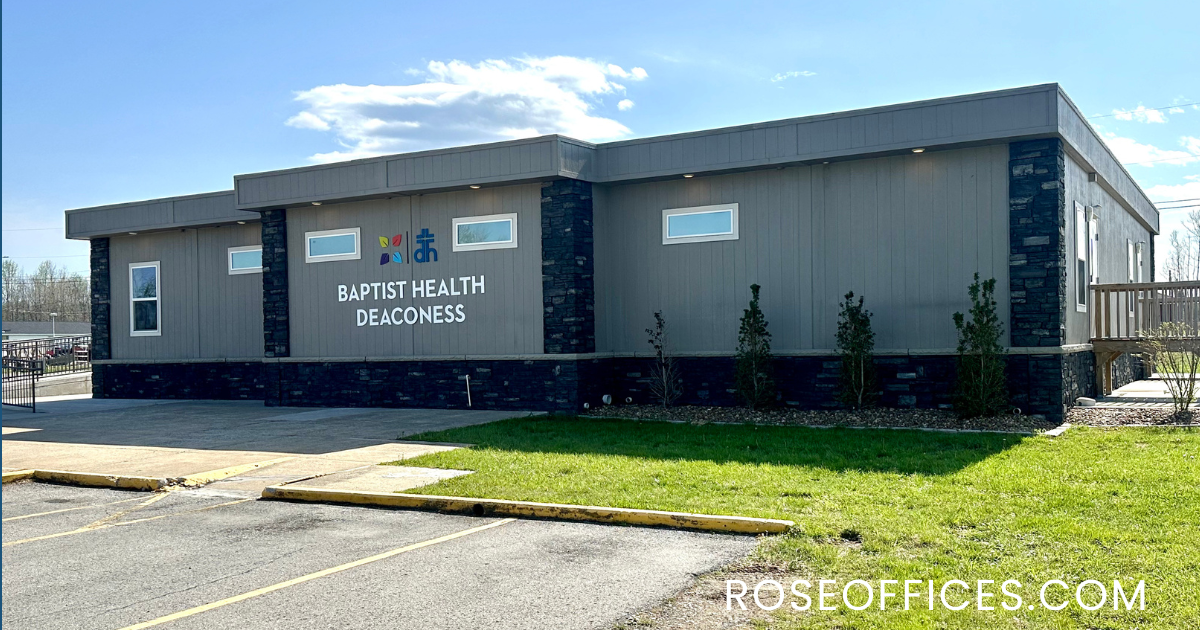
The Pivot: Swapping a Modular Clinic Already in Production
Faced with an impossible timeline, Garry Cain at Rose Office Systems found an ingenious logistical workaround.
Coincidentally, Rose had a fully functional medical clinic already in production at our factory, originally built for a hospital in South Carolina and scheduled to be leased to them for 36 months. Recognizing the immediate emergency in Dawson Springs, we negotiated between the South Carolina hospital and the Baptist system. The South Carolina partner agreed to let that clinic go to Dawson Springs immediately, while we built a duplicate replacement clinic right behind it for South Carolina.
Overcoming Rigid Kentucky Code Hurdles
Because the clinic in production did not have Kentucky state codes attached to it—and Kentucky’s inspection process is notoriously rigid—time was of the essence. Rose negotiated directly with Kentucky state inspections to secure an emergency relief exception.
This allowed us to install the building first and handle code compliance inspections after installation, completing a few necessary additions on-site to meet full Kentucky code compliance. Rose handled every step of that process.
Because of this agility, within 6 weeks of the tornado, patients were being seen out of a brand-new, fully functioning medical facility instead of a tent.
From Temporary Fix to Permanent Upgrade: The Happy Ending
Initially, the modular building was brought in as a temporary solution until the health system could secure funds and time to build a permanent replacement. But once the staff and patients experienced the new facility, everything changed.
The new Rose clinic featured modern, up-to-date colors, specialized exam layouts, and strict code compliance that was far and away better than their 1980s predecessor. Seeing the incredible quality and immediate impact, the clinic staff petitioned the Baptist system leadership to simply buy the modular building and make it their permanent new home.
When Baptist leadership came down for the official facility dedication, everyone agreed: rather than putting patients and staff through the trauma of moving twice, the Vice President was so impressed that he bought the Rose modular building outright instead of leasing it.
A Recommendation Letter Worth Framing
The success of this project produced one of the best reference letters Rose Office Systems has ever received. Here is an excerpt from leadership on the impact of the project:
“The speed, quality, and professionalism with which Rose Office Systems delivered our replacement clinic after the devastation in Dawson Springs was nothing short of remarkable. They turned an impossible situation into a beacon of hope for our community in a matter of weeks, providing a facility that far exceeds our previous space and allows us to deliver exceptional care when our patients needed it most.”
Since this successful deployment, many other facilities within the Baptist health system have partnered with Rose Office Systems for their own expansion and replacement projects.
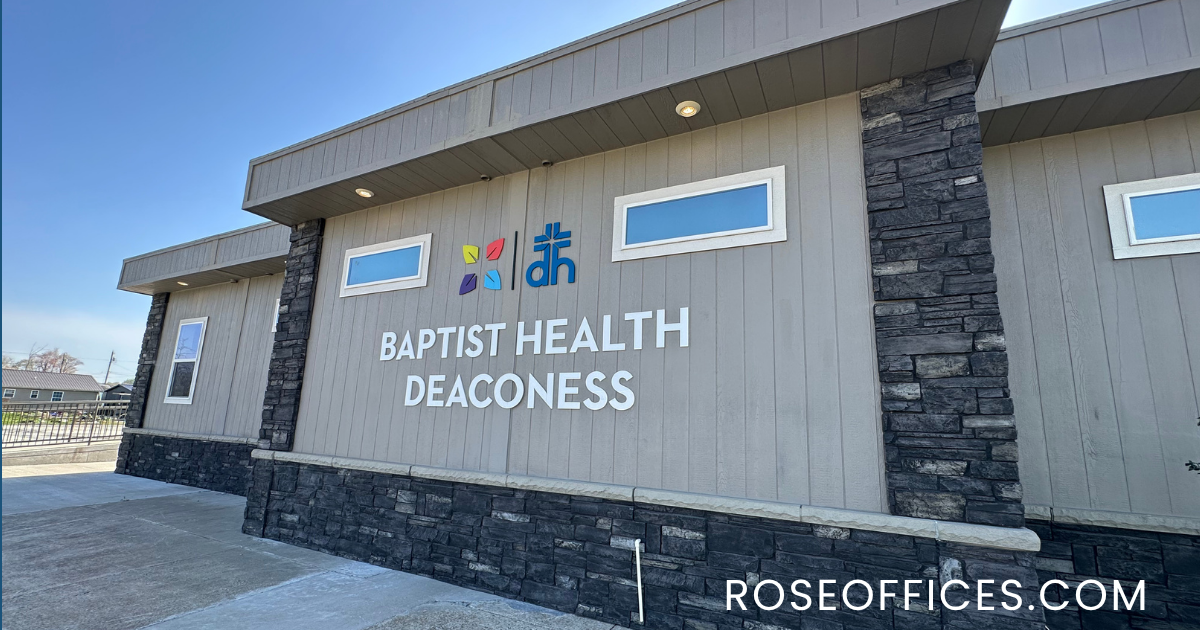
When Disaster Strikes, Rose Is Ready
The success in Dawson Springs is part of a much longer history of emergency response. Rose Office Systems has stepped in to provide rapid-deployment buildings for communities facing natural disasters and crises nationwide. A few examples:
-
Hurricane Katrina Relief (Gulfport, MS): Rose worked with Operation Blessing International to deliver modular office solutions to the hardest hit areas of Louisiana and Mississippi. Rose also designed and delivered a fully functional modular funeral home to Gulfport to help a devastated community handle critical end-of-life services when local infrastructure was completely gone.
-
Cordova, AL Tornado Rebuild (2011): Following the historic April 27, 2011 tornado outbreak, Rose rebuilt the destroyed Ralph Haskett Memorial Clinic, complete with advanced diagnostic screening space and an integrated pharmacy.
-
Rural Church Rebuilds: Partnered closely with the Alabama Baptist Association to provide new, welcoming meeting spaces after arsonists burned numerous churches across rural Alabama.
Whether it’s a tornado, a hurricane, severe flooding, or an unexpected emergency, Rose Office Systems is built to respond when time matters most.
Got a timeline that feels impossible? Let’s talk about what’s actually possible. Contact Rose Office Systems Today
How Modular Construction Makes Disaster Recovery Possible
Disaster Recovery That Restores Community, Not Just Infrastructure
Tornadoes, floods, and ice storms don’t wait for convenient seasons. They can happen year-round, no matter your location. When disaster destroys a healthcare facility, the community loses far more than a building.
Stick-built reconstruction can take 18+ months. During that time:
- Patients without local care start traveling further, some stop going entirely
- Preventive care gets skipped; chronic disease management suffers
- The community’s sense of stability—already shattered by disaster—erodes further
- The clinic’s patient base migrates to other providers and often doesn’t return
With modular construction, the clinic doesn’t just recover faster. The community recovers faster.
Patients can return to familiar providers in a clean, new clinic. Trust gets rebuilt. Healthcare access gets restored alongside physical recovery.
For Dawson Springs after the December 2021 tornado, this was everything. The clinic came back online while the community was still processing the disaster. That continuity of care mattered.
Future-Proofing Healthcare in Disaster-Prone Regions
Healthcare facilities in tornado alleys and flood-prone areas face an ugly reality: “If disaster destroys our clinic, can we afford to rebuild fast enough to survive as a business?”
With stick-built construction, the answer is often no. An 18-month rebuild closes the clinic, patients and providers leave, and the facility never fully recovers.
Modular construction changes that equation. If disaster strikes, your clinic can be back online in months, with your community’s healthcare access actually restored.
Healthcare facility managers in tornado alleys, flood zones, and hurricane-prone areas are increasingly choosing modular construction as disaster insurance. It costs less than traditional construction, delivers faster, and if disaster hits, recovery is measured in weeks instead of years.
FAQ Modular Healthcare Facilities for Disaster Recovery
Q: Can modular buildings really be deployed fast enough for emergency disaster recovery?
A: Yes. While traditional stick-built reconstruction takes 18+ months, modular healthcare buildings are constructed off-site in parallel with site preparation. By leveraging units already in production or fast-tracking manufacturing, facilities can go from disaster site to seeing patients in weeks.
Q: How do you handle strict state code compliance on short-notice modular projects?
A: Through proactive coordination with state regulatory and inspection agencies. In emergency situations like Dawson Springs, Rose works directly with state code officials to secure emergency relief allowances, allowing for post-installation inspections and on-site adjustments so facilities open safely and quickly without sacrificing code standards.
: Are modular medical clinics high enough quality to serve as permanent facilities?
A: Absolutely. While often deployed as temporary relief, modern modular healthcare buildings feature medical-grade HVAC, specialized electrical loads, durable finishes, and contemporary layouts. As seen in Dawson Springs, staff and leadership frequently choose to make them permanent because they outperform older, legacy brick-and-mortar buildings.
Q: Are modular buildings really code-compliant for medical facilities?
A: Yes. Rose designs and builds modular healthcare facilities to full medical building codes, including NFPA 101 (Life Safety Code), utility load requirements for medical equipment, and state/local health department standards. Every module is factory-inspected before delivery. Off-site construction actually improves code compliance because inspections happen in controlled conditions, not in the field.
Q: How fast can you build a modular clinic?
A: Timeline depends on your scope, but typically 6-8 months from order to move-in-ready. That’s faster than traditional construction. Your site work (foundation, utilities) happens in parallel, so by the time modules arrive, you’re ready to go.
Q: What if we need customization?
A: That’s what we do. Every clinic is different—patient volume, workflow, existing site constraints, equipment needs. We design each modular clinic to your specs. Customization happens in the factory, not on-site, which keeps your timeline predictable.
Q: Can modular buildings withstand tornado, hurricane, and severe weather damage?
A: Modular buildings meet or exceed traditional construction standards for wind, snow, and seismic loads. Every connection is engineered for the specific load conditions in your location—including tornado zones and hurricane-prone areas. We like to say that they get tested at 70 mph winds just delivering from the factory to your jobsite. If they can withstand transport, they can withstand high winds.
Q: What happens to my modular clinic if we need to relocate later?
A: Modular buildings are designed to be relocated or expanded. If your clinic grows or needs to move, your modular facility can be reconfigured or relocated far more efficiently than a stick-built structure.